MacLochlainns Weblog

Michael McLaughlin’s Technical Blog

Site Admin

Oracle 11g on Windows 7

with 25 comments

I finally got around to installing Oracle 11g on Windows 7 Professional Edition, 64-bit. The only catch was that the Oracle 11g (11.1.0.7) installer validates only against Windows 5.0, 5.1, 5.2 or 6.0. Windows 7 is actually Windows Code Base 6.1, as seen in this screen shot after successful installation:
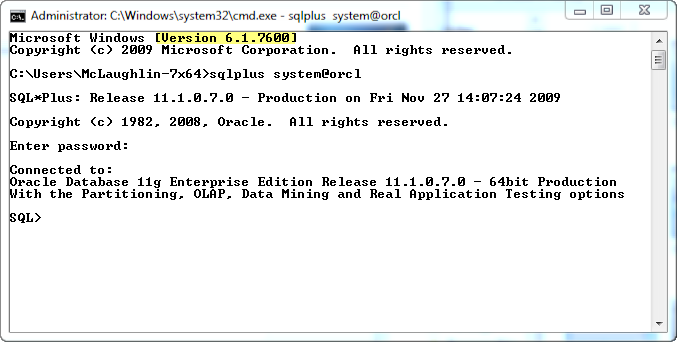
Windows7VersionScreen

With that knowledge, first you should download the software from Oracle’s web site. You should unzip the contents into another directory. I used a C:\Stage directory. Inside that you’ll find the database directory, and it should look like this:
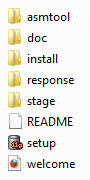
Oracle11gFolder

  1. Click on the setup icon to launch the installer. You should then see the following screen shot. Enter a password for the SYS and SYSTEM users (if you’re coming to Oracle from a MySQL background they’re like the root user in MySQL). When you’ve entered a matching password in both fields, the Install button becomes active. Click the Install button to proceed.
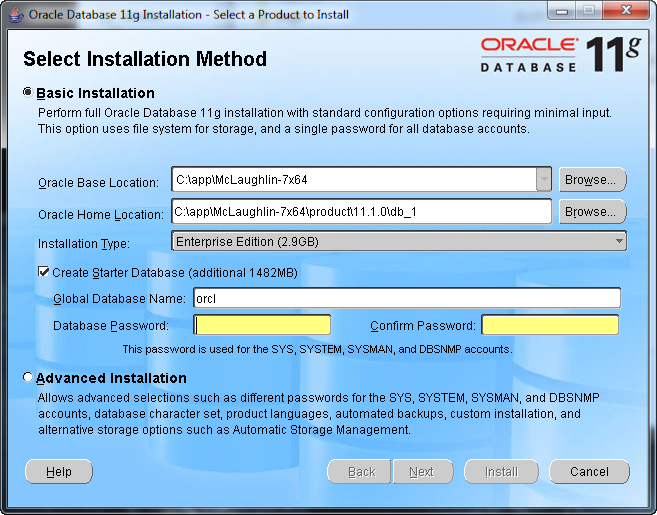
Oracle11gInstall01

  1. In this screen, you’re prompted for your Email and MetaLink Password. If this is a test database (a throw away instance without any real data), you can uncheck the box for automatic security updates. You should enter a password even for test databases. Click the Next button to proceed.
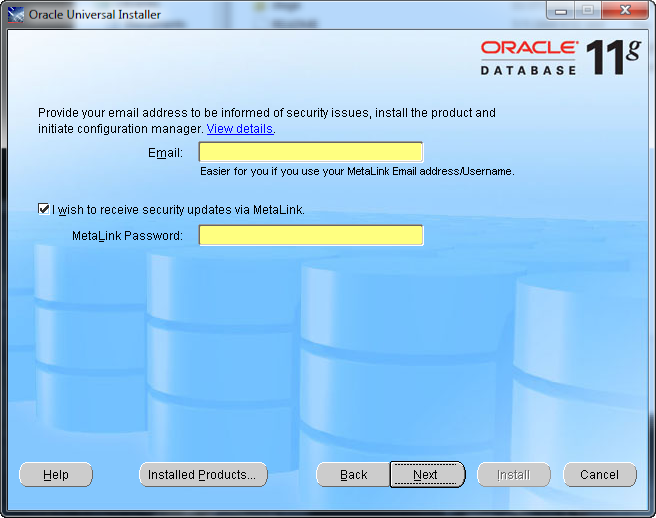
Oracle11gInstall02

  1. You’ll only see this failure if you’re installing Oracle 11g (11.1.0.7) on a Windows 7 operating system, which is actually version 6.1 according to their code control numbering. You simply check the Checking operating system requirements … and Checking service pack requirements … to override the prerequisite checks. Another error that you may encounter is related to networking. It is a warning and occurs when you’re operating system uses DHCP to get its IP address. You really should configure the operating system with a static IP address. You can set a static IP address in Windows 7 with these instructions.

Oracle11gInstall03

The checked boxes now say User Verified, which means we’re all really powerful, aren’t we? :-) Click the Next button to proceed.

Oracle11gInstall04

  1. At this point, you’ll get a Windows System Alert asking you to unblock the installer’s javaw.exe program. You must grant the access or forget about installing Oracle 11g. Click the Allow access button to proceed.

Oracle11gInstall05

  1. The dialog tells you what will be installed. Click the Install button to proceed.

Oracle11gInstall06

  1. This is the installation progress dialog. It’s running while the Oracle Installer lays down the operating system files for the database management system. It takes about 8 to 9 minutes, so stretch your legs if you want to take a break. When it’s 100% complete, click the Next button to continue.

Oracle11gInstall07

  1. After the installation, you’ll see the first of the Configuration Assistants, which is the Oracle Net Configuration Assistant (unfortunately, I didn’t capture that screen shot but I provided a temporary substitute until I re-install it). Provided everything happens successfully, it’ll move to the next step without your intervention.

Oracle11gInstall08a

You should receive another Windows Security Alert (aren’t we glad that I already disabled UAC). You need to click the Allow access button to let java.exe proceed with the installation.

Oracle11gInstall08b

  1. This one is exactly where it belongs. It means you have approximately a 5 to 6 minute break while a sample database instance is cloned for you. The cloning process copies a sample compressed database from the installation staging area to your local operating system.

Oracle11gInstall09a

It will prompt you if you want to open any of the other scheme. You can skip this and do it later, or click Password Management to open those scheme and set passwords for them.

Oracle11gInstall09b

  1. The last Configuration Assistant is the Oracle Configuration Manager Configuration. It’s a short process, it configures the cloned sample database against your installation names and passwords. When it completes it enables the Next button. Click the Next button to complete the installation.

Oracle11gInstall10

  1. You’ve finally reached almost the end of the installation. Click the Exit button on this dialog to proceed to the “are you sure” dialog box.

Oracle11gInstall11

Confirm you meant it, by clicking the Yes button on the final dialog message below.

Oracle11gInstall12

You’ve successfully installed Oracle 11g on Windows 7.

Written by maclochlainn

November 27th, 2009 at 6:35 pm

25 Responses to 'Oracle 11g on Windows 7'

Subscribe to comments with RSS or TrackBack to 'Oracle 11g on Windows 7'.

  1. Thanks for the great post,
    really helpful and easy to follow.

    Inbal

    15 Dec 09 at 4:08 am

  2. Thank you very much for saving me hundreds of hours that could have been wasted trying to install the Oracle 11g on Windows7. On my first laptop it installed without any problems. But when I got the HP laptop I had some problems. Just checking the checkbox it went smoothly. You are my Oracle 11g saver. Once again thank you very much.

    Regards,
    Sacikumar

    SKD

    4 Jan 10 at 9:56 am

  3. Thanks man, I had doubts about installing 11g on Window 7, but your post convinced and guided me to do it.

    Louis Ezeanya

    3 Feb 10 at 10:02 am

  4. Thanks, but I don’t know if that works properly with windows 7 ultimate or not. What release of Oracle 11g are you downloading?

    emmy

    3 Feb 10 at 2:02 pm

  5. I used Oracle Database 11g Enterprise Edition (11.1.0.7) for Microsoft Windows Server 2008 (x64). Naturally, it was the 64-bit version of Windows 7. Are you encountering a specific problem?

    maclochlainn

    3 Feb 10 at 4:40 pm

  6. Hi

    I used this link to install Oracle 11g on my windows 7, it works great. Thanks for the good tips and nice screen shots.. Thanks a ton…

    regs
    Jaya

    Jaya

    4 Feb 10 at 2:41 pm

  7. Hey,

    Thanks a lot for the guidance. I am planning to install the same on my Win-7-64 bit laptop. One question: What if we continue ignoring the warning due to DHCP? In other words, do I need to necessarily configure the OS with a Static IP? How would it affect my installation?

    Thanks in advance.

    Adi

    Adi

    6 Feb 10 at 3:27 am

  8. Adi,

    Like prior editions of the Windows port of Oracle Database 11g, you can ignore the DHCP warning provided you’ve taken steps to work around it. If you’ve not taken these steps with the hostname configuration, you may run into problems and certainly disable the Oracle Enterprise Manager (OEM).

    These are the added configuration steps for a DHCP install:

    1. Before installing the product, change the C:\WINDOWS\System32\drivers\etc\hosts file by adding this line beneath the default localhost line:

    127.0.0.1       localhost
    127.0.0.1       mclaughlin11g mclaughlin11g.techtinker.com

    2. Change the Windows hostname by navigating: Start > Control Panel > System (classic view) from Microsoft’s default assignment of a hostname.

    3. Reboot the machine.

    If you’ve already installed and are encountering problems connecting to SQL*Plus after performing the aforementioned steps, then do:

    1. Change the %ORACLE_HOME%\network\admin\listener.ora file from an IP number to machine name.

    2. Change the %ORACLE_HOME%\network\admin\tnsnames.ora file from an IP number to a machine name.

    3. You can reconfigure your Oracle Enterprise Manager by following the steps in this older post.

    4. Reboot the machine. You should also delete any Oracle files remaining after you’ve uninstalled the Oracle Programs. The reboot is the only way to reset the Windows Registry values for a new installation, and then sometimes conflicts exist between Oracle releases. A fresh Registry is always the safest route with an Oracle installation.

    maclochlainn

    6 Feb 10 at 9:41 am

  9. thanks! this works for the client, too. i was clicking the 1st box but not the 2nd, so you saved me some headache.

    donna

    6 Feb 10 at 3:33 pm

  10. Hey there,

    Thanks for the prompt response but I must confess I am not a techie so I did not understand a few things :

    1. In the 1st step, what exactly do I need to do? What is similar to “mclaughlin11g mclaughlin11g.techtinker.com” on my computer? I located the hosts file but I am unable to figure out what line to add exactly.

    2. In the 2nd step, I could not find the hostname. Where to find it and if I find it, what should I rename it as?

    Those are the questions I have. I would be thankful if you can answer them.

    Adi

    Adi

    7 Feb 10 at 11:35 pm

  11. Adi,

    Let’s work on question #2 first. You can open a command prompt by going to Start -> Run, then enter cmd in the dialog. This launches a command-line shell, it’s easiest because otherwise the navigation shifts with each release of Windows. In this command-line, type the following:

    C:\> hostname

    It’ll return your hostname. You don’t really have to change it but if you want to do so let me know and I’ll post something for you across a few versions of Windows next week. Unfortunatley, I’m in Fort Worth attending a course this week and can’t do that remotely for Windows 7.

    Questions #2, just substitute the hostname value for mclaughlin11g. The rest would be your domain, which you can get away with setting to whatever you want or simply only enter your hostname. Most folks set it to the same as their place of business on a laptop. That way it works within the corporate network.

    Hope this helps.

    maclochlainn

    7 Feb 10 at 11:45 pm

  12. Hi,

    i have a problem with oracle client…
    I had Oracle 10 g which did not even show up in the Add or Remove programs.. :(
    I uninstalled it and installed 11g, that got successfully installed, now, when i open the Sql+, it throws a screen and asks for username and password…
    In the password section nothing shows up, even if i enter something..
    On hitting enter…

    It gives a messages as ORA:1250 : TNS Protocol adaptor error..

    Any suggestions?
    Please help..

    pankaj

    12 Feb 10 at 12:17 am

  13. It’s a guess but you probably uninstalled Oracle 10g before you installed Oracle 11g. There are a number of possibilities that may be causing this type of problem on a Windows platform. The easiest solution is to check your %PATH% variable first, like this:

    C:\> echo %PATH%
    C:\app\Administrator\product\11.1.0\db_1\bin;C:\WINDOWS\system32;C:\WINDOWS;C:\WINDOWS\System32\Wbem;C:\Program Files (x86)\Zend\Core For Oracle\bin;C:\Program Files (x86)\Vim\vim72;C:\Program Files (x86)\Notepad++

    You can set the %PATH% and %TNS_ADMIN% environment variables like this:

    C:\> set PATH=C:\app\Administrator\product\11.1.0\db_1\bin;%PATH%
    C:\> set TNS_ADMIN=C:\app\Administrator\product\11.1.0\db_1\network\admin

    If this fixes your problem, you’ve got the old path statements in your Windows master path. You can edit that through the Windows interface or write a script file to set these as noted above. If it doesn’t work, post the results of the echo statement and the contents of the tnsnames.ora file.

    maclochlainn

    12 Feb 10 at 1:52 pm

  14. hey pankaj!!!!! i had the same problem
    here is the solution, go to services and check
    whether that all the services of oracle are running.
    you can set the start type of these services as manual so that you can start them manually so that they don’t eat up your resources

    abhishek

    15 Feb 10 at 1:24 pm

  15. Abhishek,

    Generally, a stopped listener service raises an ORA-12541 error, a paused listener service raises an ORA-12518 error; and a stopped Oracle Service raises an ORA-12514 error. It didn’t seem like that’s the problem because he’s encountering an ORA-12500 error. If you fixed an ORA-12500 by simply starting the service, I’d suspect you have too much running during startup and encountered a memory error. I’ve a list that continues to grow network troubleshooting here. If you’ve more information that you’d like to add, please drop me a note on that page. Thanks for sharing!! :-)

    Typically, an ORA-12500 occurs on the Windows platform in two places. First, when the service was created by somebody other than the Administrator, which can be a user with Administrator role but not in the Administrator group. Second, when the machine doesn’t have enough physical or virtual memory to spawn a new dedicated process.

    Sometimes a prior install was done by the Administrator, and a subsequent install done by a user with less privilege. Typically, that means that the global path isn’t updated by the installer. That’s why I asked about the %PATH% and %TNS_ADMIN% variables. I probably should have just put this in with the original reply.

    maclochlainn

    15 Feb 10 at 2:11 pm

  16. Hi,

    I’m having issues with Access and the ODBC connection on Win7 64 bit. I have configured both the wow64 one and the 32 bit within the controlpanel. Any clues?

    PS: The test connection do not raise any errors!

    Kurt Bilde

    19 Feb 10 at 3:37 am

  17. Hi all,

    I have installed oracle11g on windows7 home edition.
    After certifying oracle11g as secure, it took me oracle Enterprise connection manager
    But in the Oracle connection manager page what username and password i should enter??

    http://www.oracle.com/technology/obe/11gr1_db/install/dbinst/windbinst2.htm#t1

    This link tells me to enter
    Enter system as the User Name and oracle as the Password, and then click Login.

    But im not able to login. Please let me know what should i do now? Thanks

    Sanjeev

    3 Mar 10 at 11:45 am

  18. Hi all..,

    I have installed oracle11g on windows7 home premium edition(32 bit).
    I followed your steps .but when trying to connect to sqlPlus using command prompt i am getting following problem.

    C:\Users\Asanka>sqlplus sys as sysdba

    SQL*Plus: Release 11.1.0.6.0 – Production on Wed Mar 10 22:42:37 2010

    Copyright (c) 1982, 2007, Oracle. All rights reserved.

    Enter password:
    ERROR:
    ORA-12560: TNS:protocol adapter error

    Enter user-name:

    Can anybody tell me what can i do to solve this…

    Asanka

    10 Mar 10 at 11:18 am

  19. Home Premium Edition doesn’t support the networking level that’s needed. It’s designed as a client software. You should get Professional or Ultimate Edition.

    maclochlainn

    10 Mar 10 at 11:32 am

  20. thank you for the reply

    Asanka

    11 Mar 10 at 6:50 am

  21. Hi,
    I sucessfully installed 11g on an off-line laptop running Windows 7 Professional and was able to get the SQL*Plus running from the CMD prompt, as you demonstrated in the box at the top of your page. However, when I try to run the EM Manager (Database Control from the start menu), if keeps telling me the webpage is unavailable because I’m offline. I installed the personal edition of 11g for some developement work with .net on the laptop, and was hoping to be able to run the EM manager offline for creating some test databases to check my code against.

    Any Ideas would be helpful.

    Thanks

    jim

    11 Mar 10 at 8:52 pm

  22. Jim,

    It’s a guess based on what you’ve written. You may also want to check this earlier blog post of mine on reconfiguring Oracle EM. A couple other things that you may what I check:

    • Are you using a static or dynamic IP port? If static, have you set the hostname in the C:\Windows\System32\drivers\etc\hosts file to the IP address? If dynamic, have you set the hostname in the C:\Windows\System32\drivers\etc\hosts file to 127.0.0.1, which is the loopback?
    • Do the listener.ora and tnsnames.ora point to a physical IP address or the hostname found in your local hosts file? If an IP address, is it your current IP address?
    • Lastly, have you checked by using the netca wizard whether you can tnsping your Oracle TNS Alias? The sample database by default installs an Oracle TNS Alias of orcl. If you did a software-only install, you should run the dbca utility to create a database of your choice.

    Hope it helps but if you’ve more questions, let us know. Others are welcome to post a comment to help Jim too. :-)

    maclochlainn

    11 Mar 10 at 11:54 pm

  23. Hi all,

    which version of Oracle database will work on Windows7 64 Bit Home Edition?

    Sanjeev

    12 Mar 10 at 1:01 am

  24. Thanks for your information on getting EM Manager to work on Windows 7 Professional. I was able to follow your steps and make everything work, with some additional work on Windows Certificates. The security on Windows 7 can be a bit overwhelming sometimes, but there are usually solutions if you work hard enough at it.

    Thanks again,

    Jim

    Jim

    13 Mar 10 at 3:35 pm

  25. If you’d like to post any of your fixes for others, please share it. I’m sure somebody else will run into it. :-)

    maclochlainn

    13 Mar 10 at 4:14 pm

Leave a Reply