Windows 7 Static IP
There are some subtle changes between Windows 7 and either Windows XP and Windows Vista. Since I use virtualization (with VMWare Fusion) extensively to test environments, I seem to go through this drill too often. By the way, I upgraded to VMWare Fusion 3 before testing the production releases of Windows 7.
The easiest Windows 7 installation uses DHCP. That’s what I did before patching the OS, installing virus protection software, and installing a few tools and program. Then, I change from a dynamic IP to static IP address and add a meaningful name to the C:\Windows\System32\Drivers\etc\hosts file. Here are the steps to set a static IP address on Windows 7:
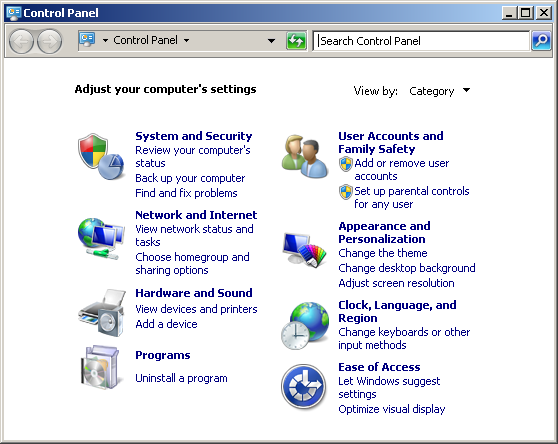
- Assuming that you’re in the Category view, you should navigate to the Control Panel, choose Network and Internet, and then click Network and Sharing Center. This is the window that you should see (click image to enlarge it):
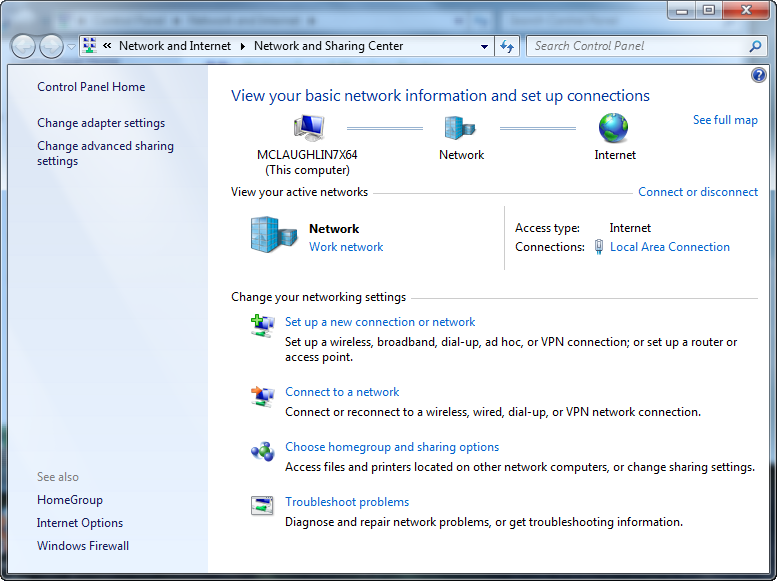
- Click the Local Area Connection to begin configuring your static IP address.
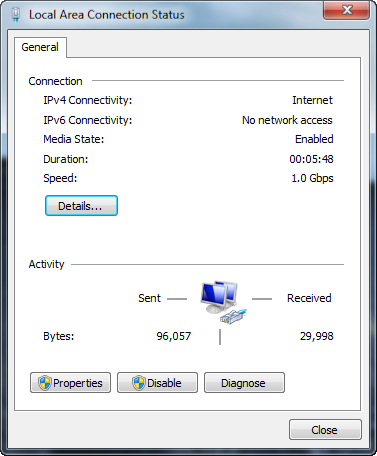
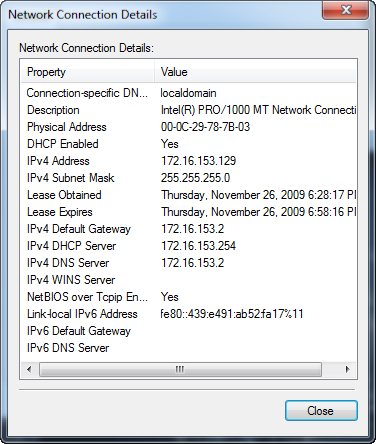
- From the Local Area Connection Status window, click the Details button to see your existing connection details (most likely DHCP). If you’re running this in VMWare Fusion, the
172.16.153.129is the first IP address allocated. You should note the default gateway and DNS server IP address, which should always be172.16.153.2. Click the Close button when you’ve made note of those IP addresses for subsequent steps.
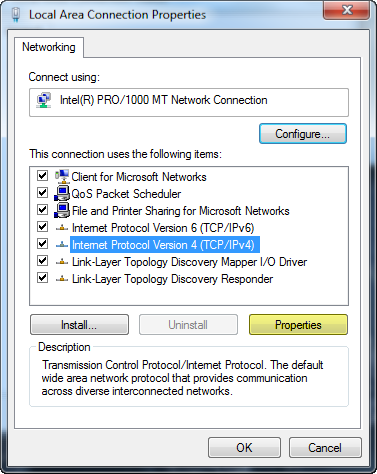
- Back at the Local Area Connection Status window, click the Properties button. It will show you the Local Area Connection Properties dialog. Click on the Internet Protocol Version 4 (TCP/IPv4) in the item box of the dialog window.
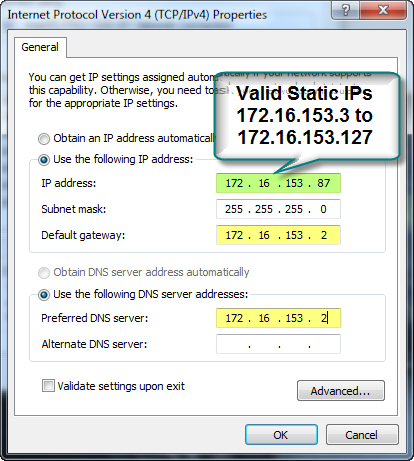
- Click the Use the following IP address radio button and enter the appropriate values for your static IP address. The default gateway and DNS server are generally different but are the same when you’re using NAT addressing inside VMWare.
You should be completed now. If you test the connection, Windows 7 raises and error but everything works after you reboot the operating system.


Will those steps be the same if I’m using a wireless connection?
anonymous
4 Dec 09 at 9:49 pm
Generally, wireless IP addresses are allotted as DHCP addresses, but you’ll need to determine the range of wireless IP addresses that are available as static IP address, then you’ll need to define the use in the DNS server.
maclochlainn
4 Dec 09 at 10:20 pm
Hi,
I am troubleshooting with the connection using static IP address. I found on your last picture, that there are the Valid Static IPs only to 127??? Is that right?
Because my internet provider gave me the IP ended by 228. Is there a problem or you can think of something else? Note: I don’t have problem to connect with my Win2000 and Linux-Ubuntu. Also the adapter is working, at work I am using Dynamic IP and there is everything fine…thanks a lot.
Roman
8 Dec 09 at 12:43 pm
It’s hard to figure out what you need from what you’ve written. Can you do the following and post the results as a followup comment?
1. Change the network settings back to DHCP.
2. Reboot the server.
3. When the server is back online, open a command shell (Run
cmd.exe).4. Run this command, and put the results in a comment:
This is the part of the output that would help me identify what you may require in your settings:
This uses 192.* because it’s single NAT’d, and the VMWare Fusion default. As a note, the posting refers to a range in the 172.* range because that’s how VMWare Fusion maps IP addresses in a double NAT’d situation. Double NAT assignments like this occur in VMWare Fusion most frequently when the host’s IP address (Mac OS X) is in the 192.* subnet.
- The range for static IP addresses is: 172.16.153.3 to 172.16.153.127
- The range for dynamic IP addresses is: 172.16.153.128 to 172.16.153.255
An alternate subnet configuration for a single NAT for most ISP DHCPconfigurations would have the following ranges with a 192.* subnet.
- The range for static IP addresses is: 192.168.0.3 to 192.168.0.127
- The range for dynamic IP addresses is: 192.168.0.128 to 192.168.0.255
Look forward to hearing from you.
maclochlainn
8 Dec 09 at 7:22 pm
The properties of the IPv4 is disabled in my windows !
how can i enable it ??
dmha
27 Jan 10 at 2:45 pm
If you navigate to the Control Panel, Network and Internet, and Network Connections, you should see a Local Area Connection icon. Click on that icon, it launches the Local Area Connection Status dialog. Click the Details … button and you’ll get the Network Connection Details dialog. In this dialog, you should see that you have either a
IPv4 Default GatewayorIPv6 Default Gateway. If you have anIPv4IP address, you should have properties for it. My guess is that you’re using anIPv6gateway, which means you should set the properties for theIPv6. The interesting thing is that even if you’re not using the other protocol, the Properties dialog shouldn’t be disabled. Are you the Administrator account on the machine or a delegated user?maclochlainn
28 Jan 10 at 12:33 am